
FLAIR20 SYNTHESIS™ FREESTYLE EVALUATION FRAMEWORK
A framework for evaluating freestyle as performance, structure, and expression.
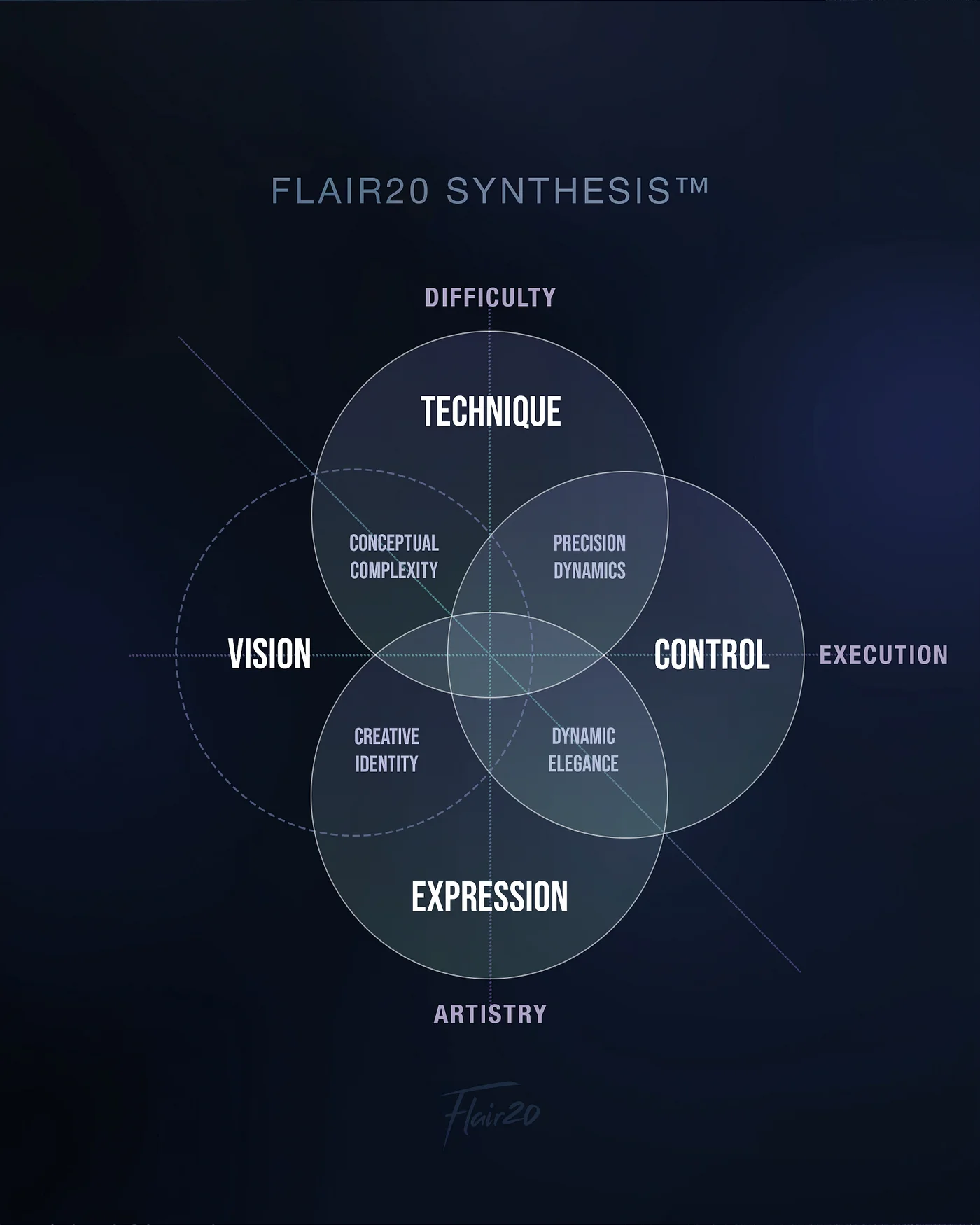
Flair20 Synthesis is a structured model for understanding and evaluating freestyle performance.
It was developed from a simple recognition: freestyle is not exhausted by technical difficulty alone. A complete evaluation must be able to recognise challenge, quality of execution, and expressive force within a single coherent framework.
Synthesis brings these dimensions together.
Core Pillars of Evaluation
|
Pillar |
Purpose |
Points |
|
Difficulty (D) |
Complexity, Risk & Innovation, Variety |
10 |
|
Execution (E) |
Control, Flow, Precision |
10 |
|
Artistry (A) |
Originality, Musicality, Presence |
10 |
-
Total score per judge: Maximum of 30 points
DIFFICULTY (D)
Measures the technical challenge, risk-taking, innovation, and the breadth and depth of the athlete’s repertoire.
-
Complexity (0-4 Points):
-
Advanced moves, intricate transitions, demanding combinations.
-
Risk & Innovation (0-3 Points):
-
Original moves or high-risk attempts that showcase invention or courage.
-
Variety (0-3 Points):
-
Breadth: Demonstrating multiple distinct freestyle families (lowers, uppers, sit-downs, groundmoves).
-
Depth: Extensive exploration within a style, demonstrating mastery and detailed variation.
Difficulty recognises what is being attempted, how demanding it is, and how far the athlete pushes beyond the ordinary.
EXECUTION (E)
Evaluates the precision, fluidity, and control of performance, including how cleanly movements are executed and how well mistakes are managed.
-
Control (0-4 Points):
-
Stable ball control, minimal drops, sustained balance and body coordination.
-
Flow (0-3 Points):
-
Seamless transitions, rhythm and tempo management, combo fluency.
-
Precision (0-3 Points):
-
Accurate and intentional ball contacts, controlled ball trajectories, clean revolutions.
Execution recognises how well the performance is carried, how stable and intentional it remains, and how effectively movement is organised through time.
ARTISTRY (A)
Assesses the expressive, creative, and performative qualities of the athlete.
-
Originality (0-4 Points):
-
Unique moves, innovative style, authentic personal signature.
-
Musicality (0-3 Points):
-
Synchronisation with rhythm, tempo shifts, musical cues.
-
Presence (0-3 Points):
-
Command, composure, opponent engagement.
Artistry recognises the athlete not only as a performer of technique, but as an author of style.
WHY SYNTHESIS
Freestyle is a discipline in which performance quality and expressive identity meet.
A serious evaluation framework must therefore be capable of recognising both. It must be precise enough to assess technical challenge and execution quality, while also remaining sensitive to originality, musical intelligence, and authored presence.
Synthesis was developed to support that fuller reading of performance.
Its purpose is to provide a framework that is structured enough to guide evaluation, and open enough to remain faithful to the nature of freestyle itself.
WHAT THE FRAMEWORK SUPPORTS
Synthesis can be used across a range of evaluative and developmental contexts, including:
- freestyle battles
- judged competitions
- showcases and performance events
- athlete feedback and reflection
- coaching and developmental analysis
- broader research into freestyle evaluation
In this sense, Synthesis functions as more than a scoring model. It provides a language for observing what freestyle performance contains.
FRAMEWORK STATUS
Synthesis Framework forms part of the wider research and development work of Flair20.
The website presents the official public framework. Further interpretive materials, professional applications, and advanced implementation pathways may develop through extended research documents, institutional contexts, and future educational formats.