
SYNERGY FRAMEWORK™
A structural framework for understanding freestyle development and creative formation.
Freestyle development can be understood through the interaction of multiple formative forces.
The Synergy Framework identifies four fundamental dimensions within this process: Technique, Control, Expression, and Vision.
Each names a distinct aspect of freestyle development. Taken together, they describe the internal structure through which movement acquires coherence, sensitivity, originality, and authored character.
The framework provides a conceptual lens for analysing how freestyle creativity takes form in practice. It supports observation, reflection, coaching, and long-range development by clarifying the relationships through which movement becomes style, and style matures into identity.
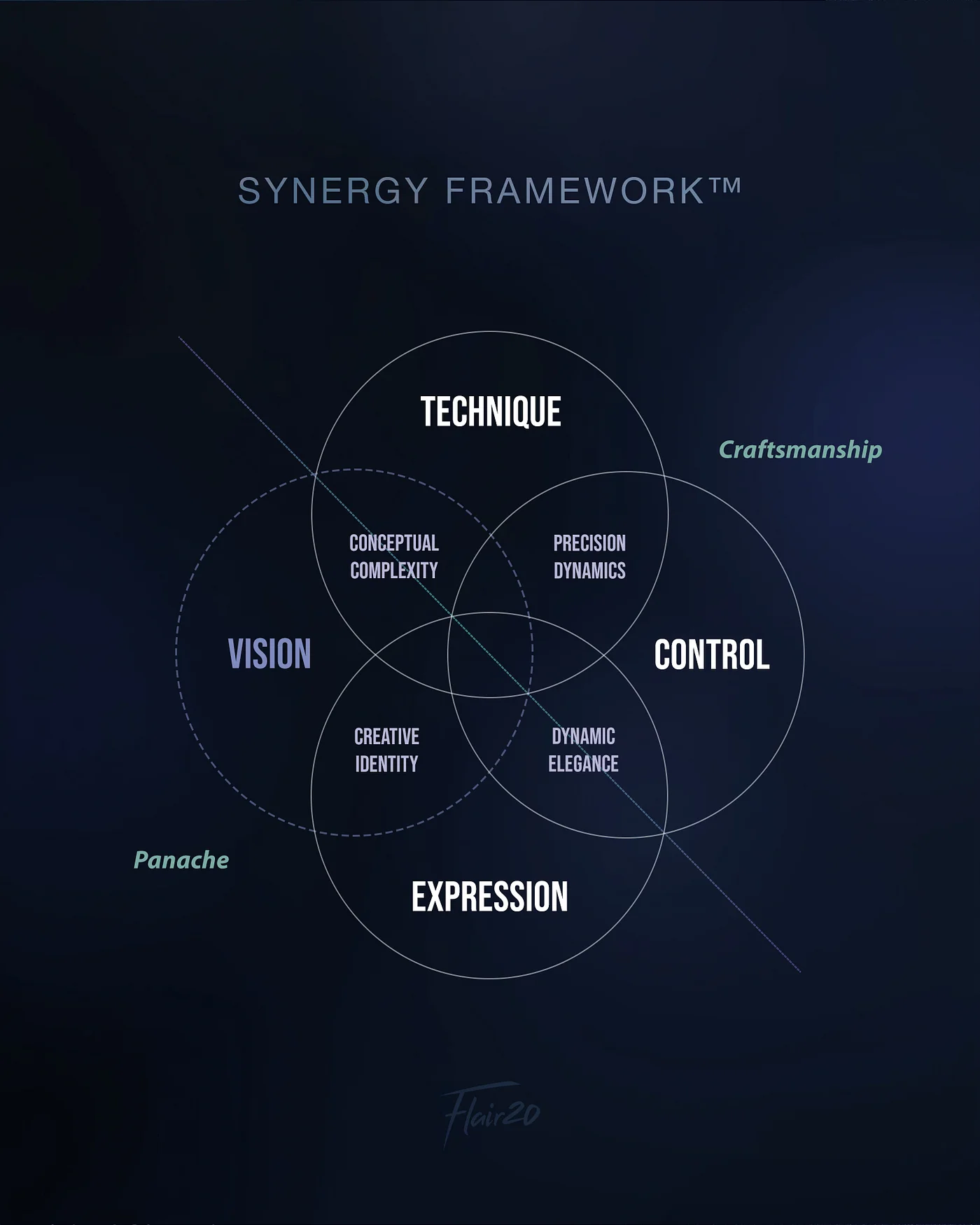
THE FOUR FORCES
Each Force describes a fundamental dimension of freestyle.
Together, they form the continuum through which creativity becomes visible.
Technique
Technique is the structural base of the craft.
It encompasses form, mechanics, timing, and the clarity of physical intention.
Strong technique stabilises creativity, offering a reliable foundation for complexity and experimentation.
Control
Control is the ability to regulate force, momentum, balance, and rhythm.
It governs how the body negotiates uncertainty and maintains coherence as difficulty rises.
Where Technique shapes the structure, Control shapes the stability that allows structure to remain intact.
Expression
Expression is where movement becomes meaning.
It carries emotion, personality, rhythm, and aesthetic tone.
Expression reveals who the freestyler is — not through words, but through the qualities and intentions embedded in motion.
Vision
Vision describes a freestyler’s conceptual imagination and creative direction.
It is the ability to design ideas, innovate consciously, and reshape the borders of what is possible.
Vision turns movement into authorship.
THE FOUR SYNERGY PAIRS
The Synergy Pairs describe the distinct creative qualities that emerge when Forces develop in close relation to one another. Each pair reveals a specific mode of freestyle intelligence.
Conceptual Complexity
(Technique × Vision)
The development of intricate and deliberate ideas through structural mastery.
It emerges when imagination is supported by the technical capacity to organise, articulate, and sustain complexity with clarity.
Precision Dynamics
(Technique × Control)
Describes the relationship between mechanical clarity and physical regulation.
It emerges in movement that retains sharpness, composure, and exactness through transition, acceleration, expansion, and pressure.
Dynamic Elegance
(Control × Expression)
Describes the shaping of flow through stability, sensitivity, and nuance.
It emerges when rhythm, weight, tempo, and intensity are regulated with such coherence that movement carries fluency, grace, and expressive depth.
Creative Identity
(Expression × Vision)
The emergence of recognisable authorship in movement.
It emerges when expressive presence is guided by conceptual direction, allowing a personal movement language to take form with coherence, distinction, and continuity.
Creative Identity begins where expressive presence and conceptual direction converge. In its fullest form, it becomes the apex of Synergy: a stabilised movement identity authored across time.
THE ESSENCE
The Synergy Framework describes the internal relationships through which freestyle matures.
As Technique, Control, Expression, and Vision develop in relation to one another, movement acquires greater coherence, sensitivity, originality, and depth. Through this process, performance becomes more than execution. A movement language begins to take shape.
Synergy is the structure through which freestyle develops from within.
It is the basis of flow, authorship, and creative identity.
It is how freestyle becomes identity in motion.